Updated Oct. 2026
Are you trying to figure out the best path to adopting AI responsibly at your school or in your district? We know it can feel like an overwhelming process determining what to prioritize and when to do it.
To help we’ve created our AI Adoption Roadmap for Schools and Districts that focuses on how to establish a strong foundation and developing an AI policy, develop your staff and update educational materials, train your students and larger school community, and continuously review how your implementation plan is going to be able to address and progress.
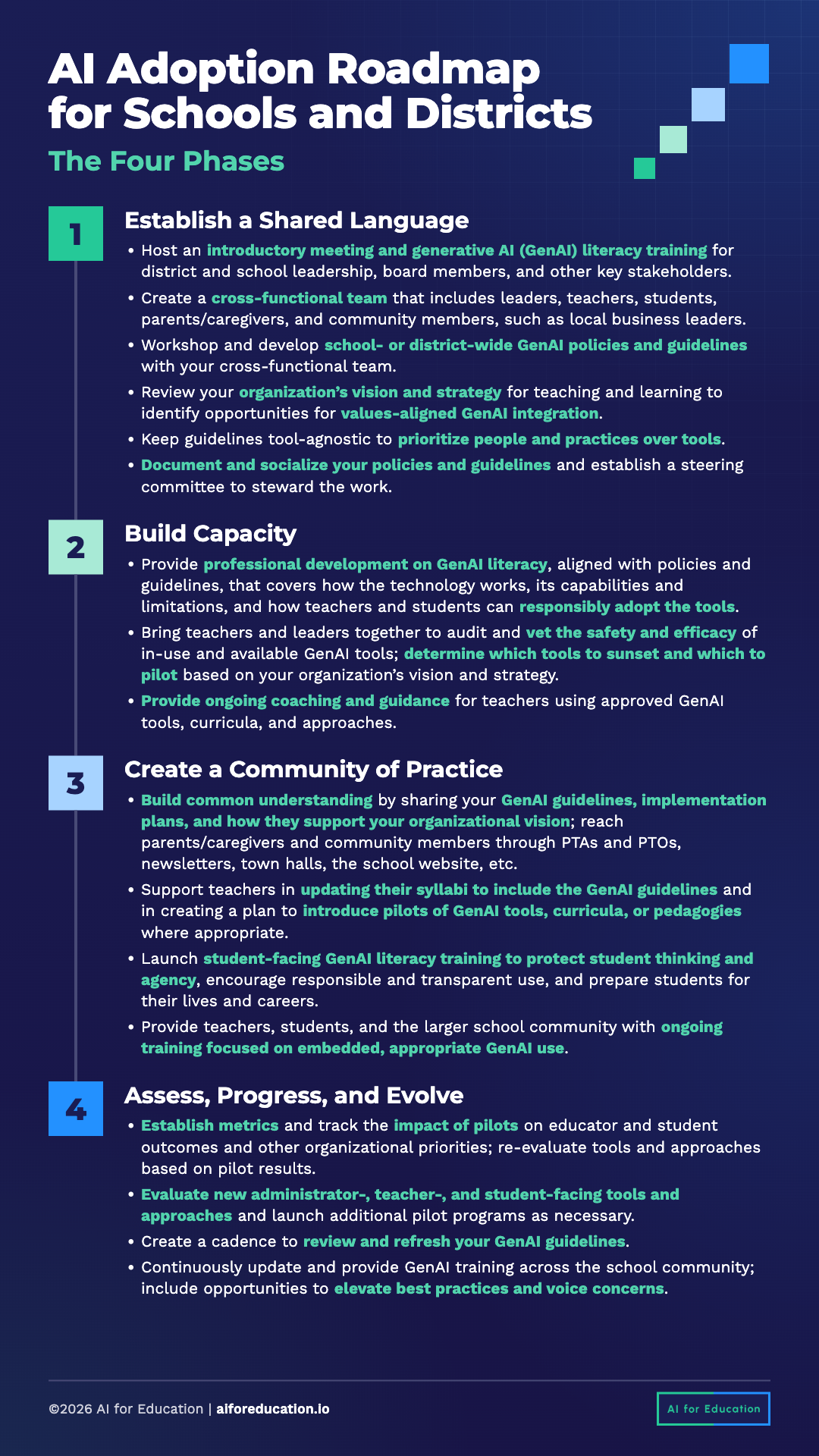
The Four Phases:
1. Establish a Shared Language
Host an introductory meeting and generative AI (GenAI) literacy training for district and school leadership, board members, and other key stakeholders.
Create a cross-functional team that includes leaders, teachers, students, parents/caregivers, and community members, such as local business leaders.
Workshop and develop school- or district-wide GenAI policies and guidelines with your cross-functional team.
Review your organization’s vision and strategy for teaching and learning to identify opportunities for values-aligned GenAI integration.
Keep guidelines tool-agnostic to prioritize people and practices over tools.
Document and socialize your policies and guidelines and establish a steering committee to steward the work.
2. Build Capacity
Provide professional development on GenAI literacy, aligned with policies and guidelines, that covers how the technology works, its capabilities and limitations, and how teachers and students can responsibly adopt the tools.
Bring teachers and leaders together to audit and vet the safety and efficacy of in-use and available GenAI tools; determine which tools to sunset and which to pilot based on your organization’s vision and strategy.
Provide ongoing coaching and guidance for teachers using approved GenAI tools, curricula, and approaches.
3. Create a Community of Practice
Build common understanding by sharing your GenAI guidelines, implementation plans, and how they support your organizational vision; reach parents/caregivers and community members through PTAs and PTOs, newsletters, town halls, the school website, etc.
Support teachers in updating their syllabi to include the GenAI guidelines and in creating a plan to introduce pilots of GenAI tools, curricula, or pedagogies where appropriate.
Launch student-facing GenAI literacy training to protect student thinking and agency, encourage responsible and transparent use, and prepare students for their lives and careers.
Provide teachers, students, and the larger school community with ongoing training focused on embedded, appropriate GenAI use.
4. Assess, Progress, and Evolve
Establish metrics and track the impact of pilots on educator and student outcomes and other organizational priorities; re-evaluate tools and approaches based on pilot results.
Evaluate new administrator-, teacher-, and student-facing tools and approaches and launch additional pilot programs as necessary.
Create a cadence to review and refresh your GenAI guidelines.
Continuously update and provide GenAI training across the school community; include opportunities to elevate best practices and voice concerns.
Credit: Julie Kelleher and Katie McFarland helped with the creation of this resource.
GenAI Disclosure Statement
This resource was developed with support from Claude, which assisted with editing, design, and layout. All GenAI contributions followed from existing human drafts and were reviewed, revised, and verified by human authors, who made all final decisions.