
From Fear to Action: Navigating AI in Education with the Ground-Build-Propel Model
Aug 25, 2026
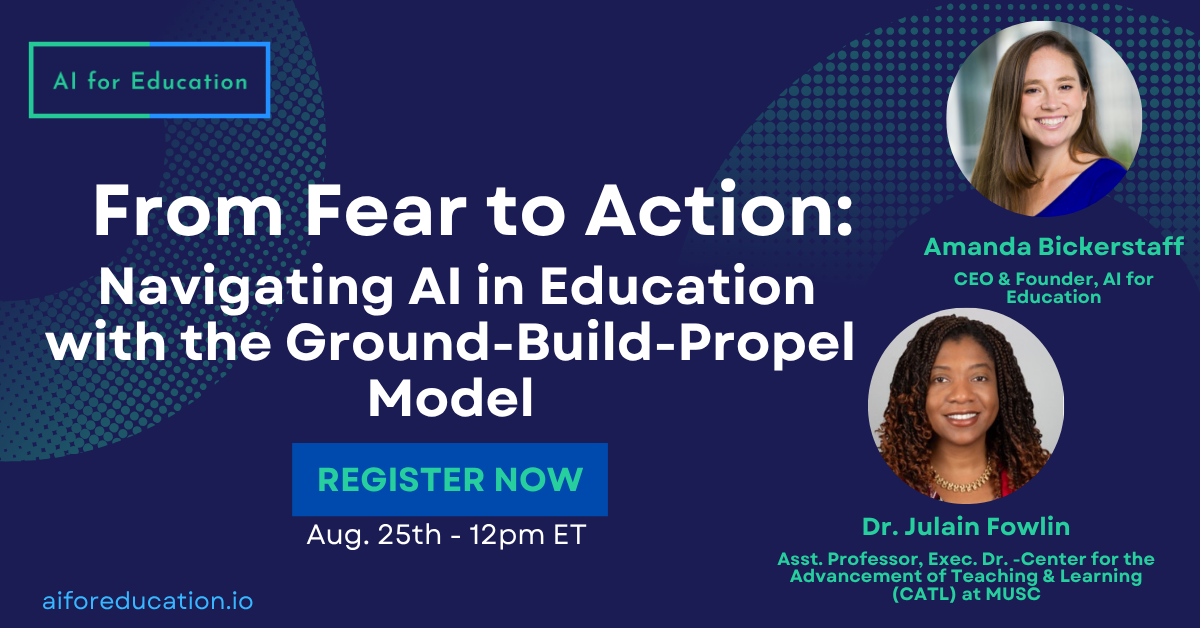
Recent research shows that unstructured AI adoption is raising serious concerns among educators about its impact on student learning. Most institutions still lack the clear guidance and strategy needed to address it.
The 2026 Stanford AI Index found that more than 80% of students are already using AI for schoolwork, yet just 6% of teachers say their institution's policies are clear (when they have them at all).
Bridging the gap between AI's presence and intentional AI integration has never been more urgent.
In our next free webinar Tuesday, Aug. 25th, we’re joined by Dr. Julaine Fowlin, researcher, educational developer, and author. She draws on her applied work across K-12 and higher education to introduce the Ground-Build-Propel Model: a practitioner-developed framework for strategic, phased AI integration.
In this session we will explore:
What the research tells us about unstructured AI adoption and its impact on student learning
How the Ground-Build-Propel Model provides a phased, practical path toward intentional AI integration
How to assess where your institution currently stands and identify your most urgent next steps
Can’t make the time? A recording + resources will be emailed to all registrants.
-
Amanda Bickerstaff
Amanda is the Founder and CEO of AI for Education. A former high school science teacher and EdTech executive with over 20 years of experience in the education sector, she has a deep understanding of the challenges and opportunities that AI can offer. She is a frequent consultant, speaker, and writer on the topic of AI in education, leading workshops and professional learning across both K12 and Higher Ed. Amanda is committed to helping schools and teachers maximize their potential through the ethical and equitable adoption of AI.
Julaine M. Fowlin, PhD
Dr. Fowlin is an Assistant Professor and Executive Director of the Center for the Advancement of Teaching and Learning (CATL) at the Medical University of South Carolina (MUSC), where she leads institutional efforts in instructional design, educational technology, faculty development, academic media, and AI in Education and Scholarship. With more than 15 years of experience in learning and development across healthcare, higher education, government, and nonprofit sectors, Dr. Fowlin is passionate about fostering collaboration, innovation, and human-centered approaches to education.
A recognized leader in artificial intelligence education, Dr. Fowlin has been instrumental in shaping MUSC's educational AI strategy and advancing the thoughtful, ethical integration of AI across teaching, learning, assessment, and scholarship. She played a key role in developing the MUSC AI Acceptable Use Framework for Academic Tasks, a shared language designed to help educators and learners navigate AI-enabled environments with transparency, trust, and academic integrity. Her work is grounded in the belief that meaningful transformation occurs when institutions invest in people, cultivate shared purpose, and create opportunities for continuous growth.
Beyond her institutional leadership, Dr. Fowlin is a researcher, educational developer, parent advocate, author, and nationally recognized voice in AI and education. She is the author of Schools Need to Adopt Clear Rules for AI Use and co-author of Empowering Educators: Operationalizing Age-Old Learning Principles Using AI. For the past three years, she has served as a mentor for the AAC&U Institute on AI, Pedagogy, and the Curriculum, supporting faculty and institutional leaders as they explore responsible, learner-centered approaches to AI integration. She is also a volunteer member of the Charleston County School District (CCSD) AI Literacy Advisory Board, helping to shape conversations around AI literacy, digital citizenship, and the ethical use of artificial intelligence in K-12 education.