
What's Working in Independent Schools: How Three Schools Are Leading on AI Literacy
Mar. 4, 2026
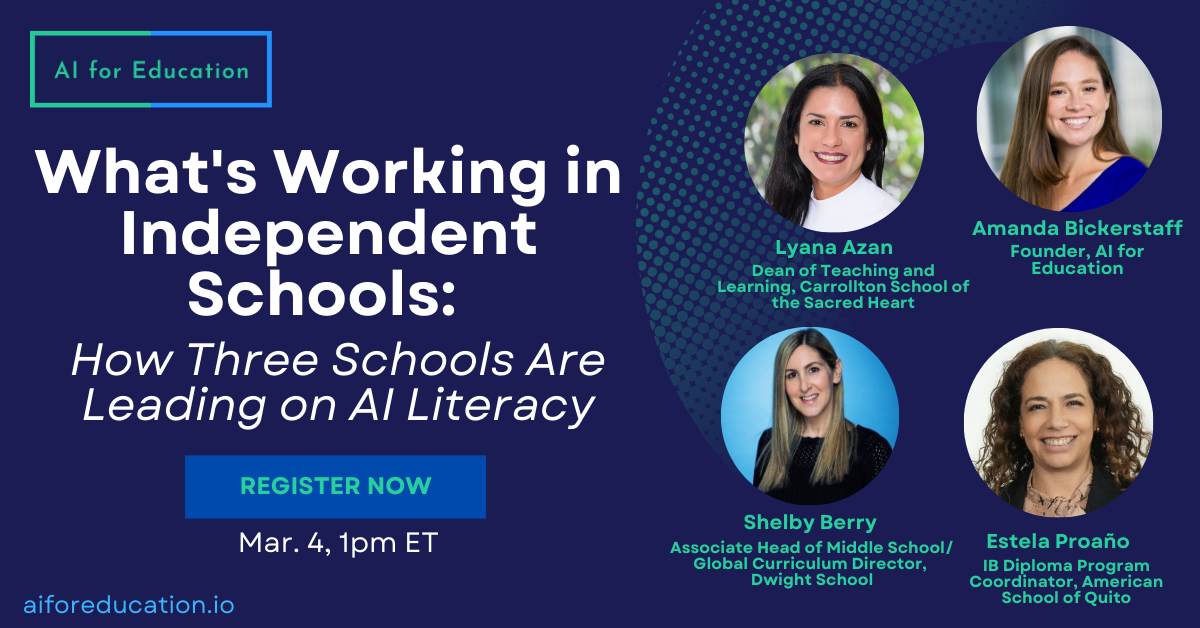
Three independent schools share their successful strategies for building AI literacy across faculty, students, and the wider school community. Hear from the American School of Quito, Carrollton School of the Sacred Heart, and Dwight School how they have made meaningful progress at every level and are seeing real results. Learn practical frameworks, implementation insights, and how to balance innovation with responsible use in your own educational setting.
In this session, we will:
Explore how to build faculty AI literacy through an intentional, structured professional development series
Discuss strategies for using student-facing events and assemblies to develop AI literacy skills across the school community
Showcase how to design and run hands-on AI literacy events that bring faculty and students together to explore AI creatively and build confidence with the technology
Examine how to establish ethical guidelines and acceptable use policies, including how the SEE Framework (Safe, Ethical, Effective) can guide real decisions about AI deployment
Discuss how to measure the impact of AI literacy initiatives and sustain momentum as the technology continues to evolve
Can’t make the time? A recording + resources will be emailed to all registrants.
-
Amanda Bickerstaff
Amanda is the Founder and CEO of AI for Education. A former high school science teacher and EdTech executive with over 20 years of experience in the education sector, she has a deep understanding of the challenges and opportunities that AI can offer. She is a frequent consultant, speaker, and writer on the topic of AI in education, leading workshops and professional learning across both K12 and Higher Ed. Amanda is committed to helping schools and teachers maximize their potential through the ethical and equitable adoption of AI.
Lyana Azan
Lyana Fernandez Azan received her B.A. in English Literature from the University of Miami in 1993 and her M.S. from Barry University in 2003. She is the Dean of Teaching and Learning at Carrollton School of the Sacred Heart in Miami, Florida, where she continues teaching the seniors International Baccalaureate English II HL. A strong advocate of teaching the whole child through inquiry-based learning, she tries to involve students in social justice issues through critical thinking and problem-solving activities. Her professional interests include the de-grading of the classroom, the connection among the mind, brain, and educational pedagogy, the promotion of independent learning, the creation of a community of scholars, – in and out of the classroom - and the role of metacognition and feedback in learning. In addition, during her twenty-six years at Carrollton, she has served as the M-12 English Department Chair, the National English Honor Society Advisor, the High School Community Read and Poetry Night Coordinator, and the Co-Chair of the Janet Erskine Stuart Teaching Fellows Program (JESTFP). Finally, she and another colleague created an Educators of the Sacred Heart (ESCJ) group whose goal is to educate faculty and staff - personally and professionally - to a deeper understanding of the Goals and Criteria, furthering our mission as ESCJ.
Estela Proaño
Estela Proaño is an international educator and school leader with nearly 30 years in education and over 20 years in leadership roles across the IB continuum. She is currently working as the IB Diploma Program Coordinator in Quito, Ecuador.
Estela focuses on helping her team move beyond reactive AI use toward informed and explicit integration. She has led the development of practical AI guidelines and professional learning experiences that support teachers, students and parents in using AI to deepen learning and maintain ethical clarity.
Estela is especially interested in how AI can be used to strengthen students’ critical thinking while also optimizing teacher time, allowing educators to focus more on feedback, relationships, and high-impact instructional decisions. She brings a grounded, classroom-connected perspective to AI implementation, consistently asking how new tools can genuinely improve instructional quality and impact while remaining aligned with IB values.