
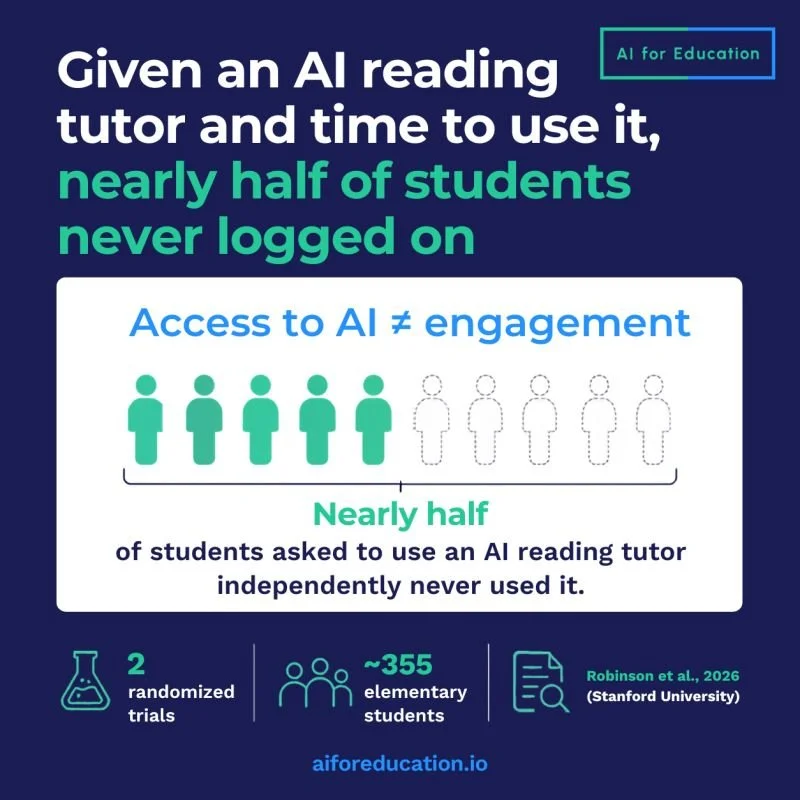
AI for Education’s CEO, Amanda Bickerstaff, was asked by the 74million to review a new Stanford study that followed ~350 elementary students across two districts who were given access to an AI reading tutor. Here is what they found.
Left to use it on their own, most students barely touched it with nearly half never logging on at all. Across all of the students, weekly use averaged just 2-5 minutes, far below the 30 minutes the developers of the tool say kids need before they see any benefit.
Pairing students with a human tutor for check-ins and encouragement had a very small impact. Usage went up by 1-4 minutes a week.
In both cases, the AI tutor didn't improve their reading scores, which tells us very little, since the tool barely got used in the first place.
None of this surprised us as we've seen the pattern before. Sal Khan, one of the earliest champions of AI tutoring, has admitted that Khanmigo was "a non-event" for many students who simply didn't use it.
While it's always good to have new research into the impact of AI EdTech tools, I'm not sure this one is even asking the right question.
The question we should be grappling with shouldn't be how to get young kids to use an AI reading tutor more often. Measuring usage was the easy part. The better question is whether these tools belong in early elementary classrooms at all.
You can find the complete article here.
You can find a link to the full Stanford study here.
