
In our workshops, we keep seeing the same thing: when students recieve good AI literacy training means more critical use of the tools.
GenAI is designed to feel effortless. You ask a question and get a fluent, confident answer in seconds. That ease is the trap. Good GenAI use takes real oversight, and most students are operating in the dark.
A new study out of France (Clerc et al., 2026) shows what changes when you teach that oversight. The researchers gave 116 middle schoolers a set of science tasks to work through with a GenAI tool.
Beforehand, 76 students attended a two-hour AI literacy workshop; the other 40 did not. The workshop wasn't just some prompting pointers. It covered how LLMs work and why they fail (hallucinations, bias, sycophancy) along with a few transferable practices like adding more context to prompts and asking follow-up questions.
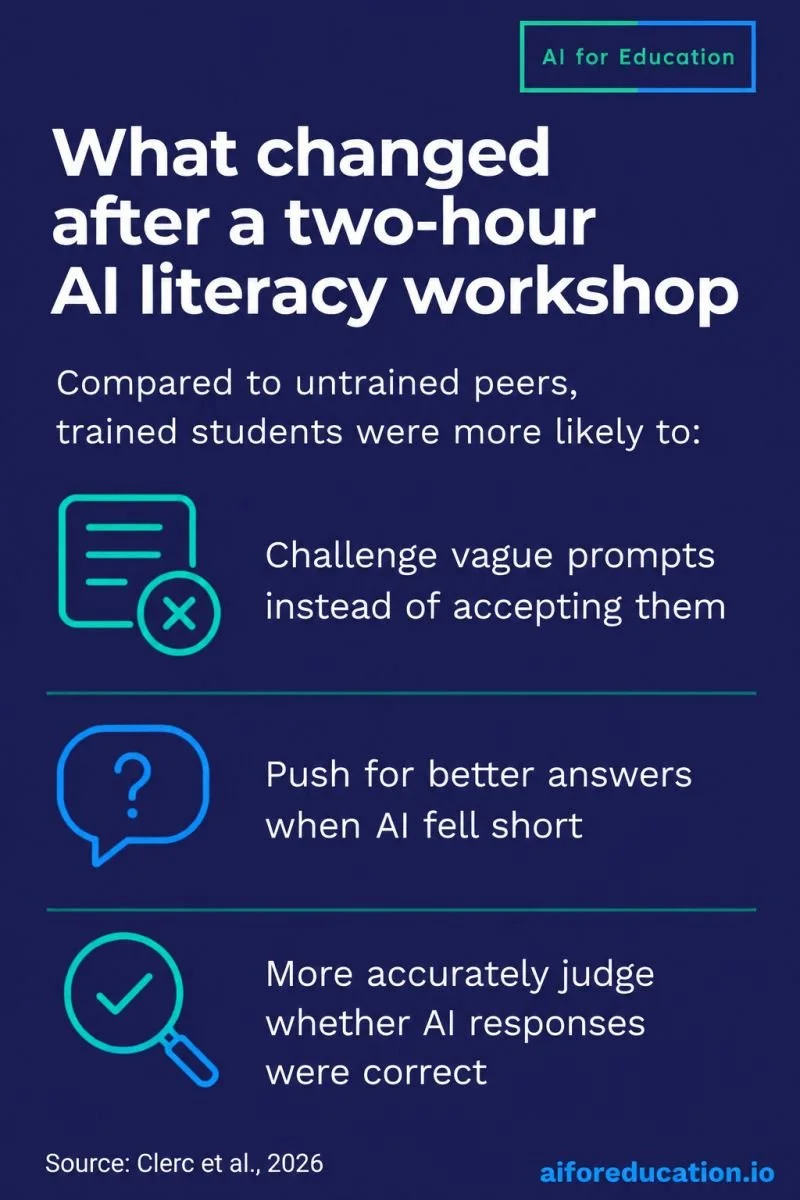
The results showed that trained students:
🔹 Were more likely to reject weak, underspecified prompts.
🔹 Asked follow-up questions to get better responses more often (59% vs. 28%).
🔹 More accurately judged whether GenAI responses were correct.
One other takeaway the evidence keeps surfacing: how confident students felt about AI didn't predict how well they used it.
While this is a small study with modest gains, it is an initial proof point that short GenAI literacy training can teach students better, more critical use of the tools.
You can find the complete study here.
