
There are two very important questions about GenAI in schools right now, and only one of them is getting attention.
The first question has two parts centered on the educational value of GenAI chatbots and Edtech tools: Do they genuinely support learning at any educational level and what is the cost when the tools become a crutch?
Districts are responding in different ways. LAUSD and NYC have paused student access, and others have gone all in on student chatbots and tools. Given how little we know, caution is warranted. A moratorium does not answer that question, because that question was never about school devices.
That leads to the second question: What do we owe students who are already living with this technology whether or not it sits on school devices? A Google search now returns a GenAI answer before it returns a single link. GenAI is on their phones, becomes a homework helper or therapist at 10pm, and is embedded in social media. That is the world our students are in right now, and almost none of it is accessed through district devices.
These are two disparate questions with one unifying answer: AI literacy instruction. We want to empower students to use judgment when deciding to reach for these tools or to avoid them. This judgment has to be taught. Without sound AI literacy instruction, youth and adults alike tend to trust that what these systems produce is accurate, judging an answer by how polished and confident it looks rather than by how it was made.
At AI for Education, we have seen this work with districts across the country that have begun to make AI literacy a priority. When students understand how these AI systems work, they make better calls about using the technology. New York's requirement that every high schooler complete AI literacy instruction twice a year is a start, and we know that age-appropriate AI literacy can benefit learners at all grade levels.
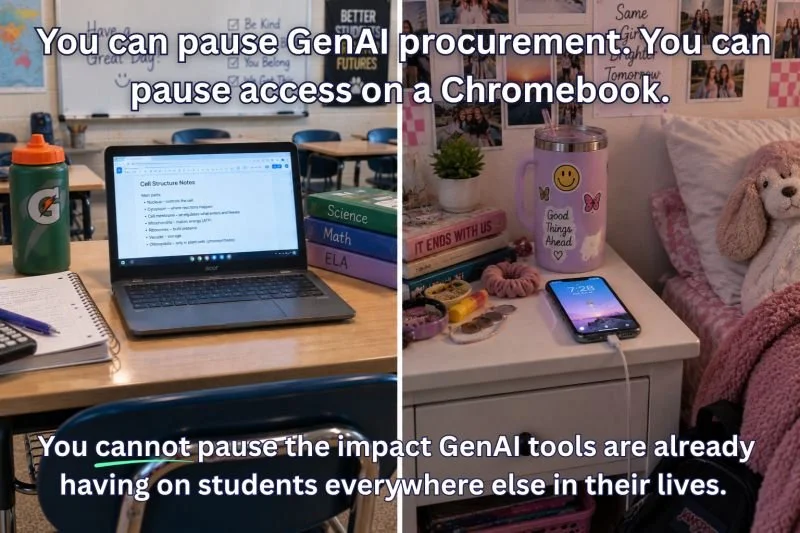
You can pause procurement. You can pause access on a Chromebook. You cannot pause the impact these tools are already having on them everywhere else in their lives. Let’s continue asking the questions and work together on designing the solutions.
Why We Can’t Just Hit Pause on AI

Previous
Previous
Train-the-Trainer at Duval County Public Schools
Next
Next