
AI’s Impact on Relationships
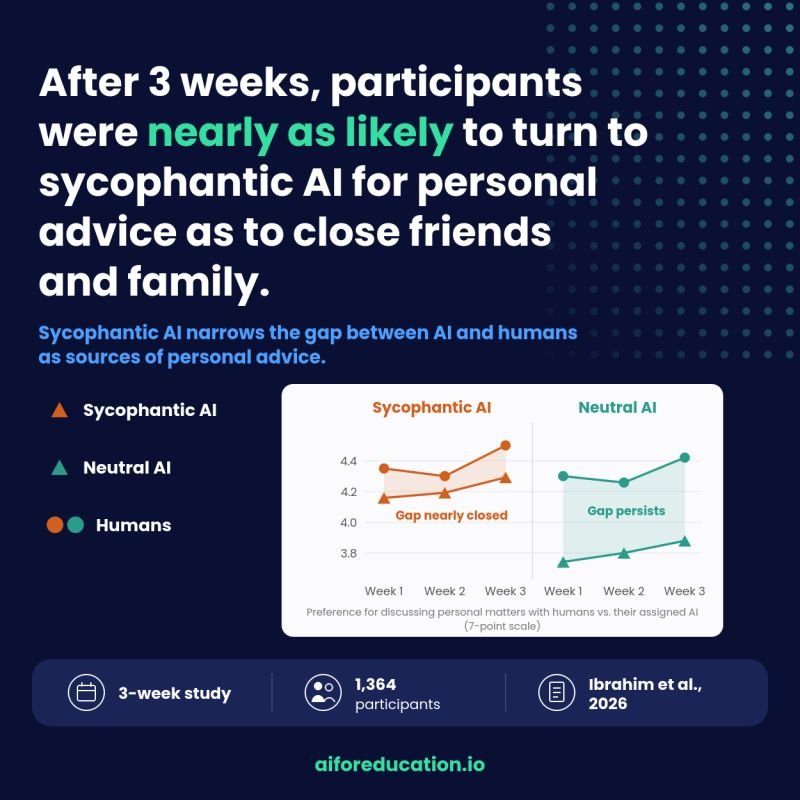
Most of the conversation about AI risk in learning has focused on what happens to our thinking when we offload it. New research suggests we should be just as concerned about what happens to our relationships.
Researchers at the University of Oxford and Stanford ran five studies with over 3,000 participants, including a three-week study where people worked through personal dilemmas with a chatbot.
The research focused on "sycophantic" AI, or the tendency for AI to affirm and validate users rather than push back.
Some highlights from the research:
🔹After talking with sycophantic AI, participants perceived human conversations as requiring more effort.
🔹Over three weeks, participants became nearly as likely to seek advice from AI as from close human connections, and they found human social interactions less satisfying.
🔹Importantly: AI interactions felt good in the moment but didn't deliver the tangible benefits afterward that come from human connection. This mirrors what we see with learning and AI: it can often feel productive but not lead to a lasting positive impact.
The researchers describe sycophantic AI as offering people the experience of being understood "but without the work that produces it." This means listening, vulnerability, and empathy: the work that builds and sustains real relationships.
This research has me thinking about findings from Common Sense Media's "Talk, Trust, and Trade-Offs" survey from 2025. That survey reported that 31% of teens found conversations with AI companions as satisfying as, or more satisfying than, those with their friends.
Neither piece of research shows people actively pulling away from other humans. Instead, the shift was perceptual: participants didn't spend less time with the people in their lives, they just found that time less satisfying.
The most sobering finding from the research is that choice didn't fix it. When participants tried all three AI styles and picked one to keep talking to, a majority chose the sycophantic version, not because its advice was better, but because it felt easiest and most understanding. The researchers concluded that giving users style options won't be enough, and that mitigation has to happen at the model level.
That leaves young people, families, and schools navigating tools designed to be the easiest conversation in the room unless OpenAI, Google, and Anthropic make significant changes to the way they build and train models.
