A practical, research-informed guide to the appropriate use of AI detectors in education.
As generative AI becomes more common in schools, educators are increasingly being asked to make decisions about student work that may involve AI. While AI detectors can seem like a straightforward solution, current research shows they have important limitations and should not be relied on as the sole evidence of academic misconduct.
This new resource summarizes what the evidence says about AI detectors and provides practical, research-informed guidance for responding to potential AI misuse. It also highlights proactive strategies that can help schools strengthen assessment practices and build AI literacy.
Download the resource to explore:
What the current evidence says about AI detectors
The limitations and risks of relying on detector scores
Practical steps to take when you suspect inappropriate AI use
Proactive strategies that strengthen assessment and AI literacy
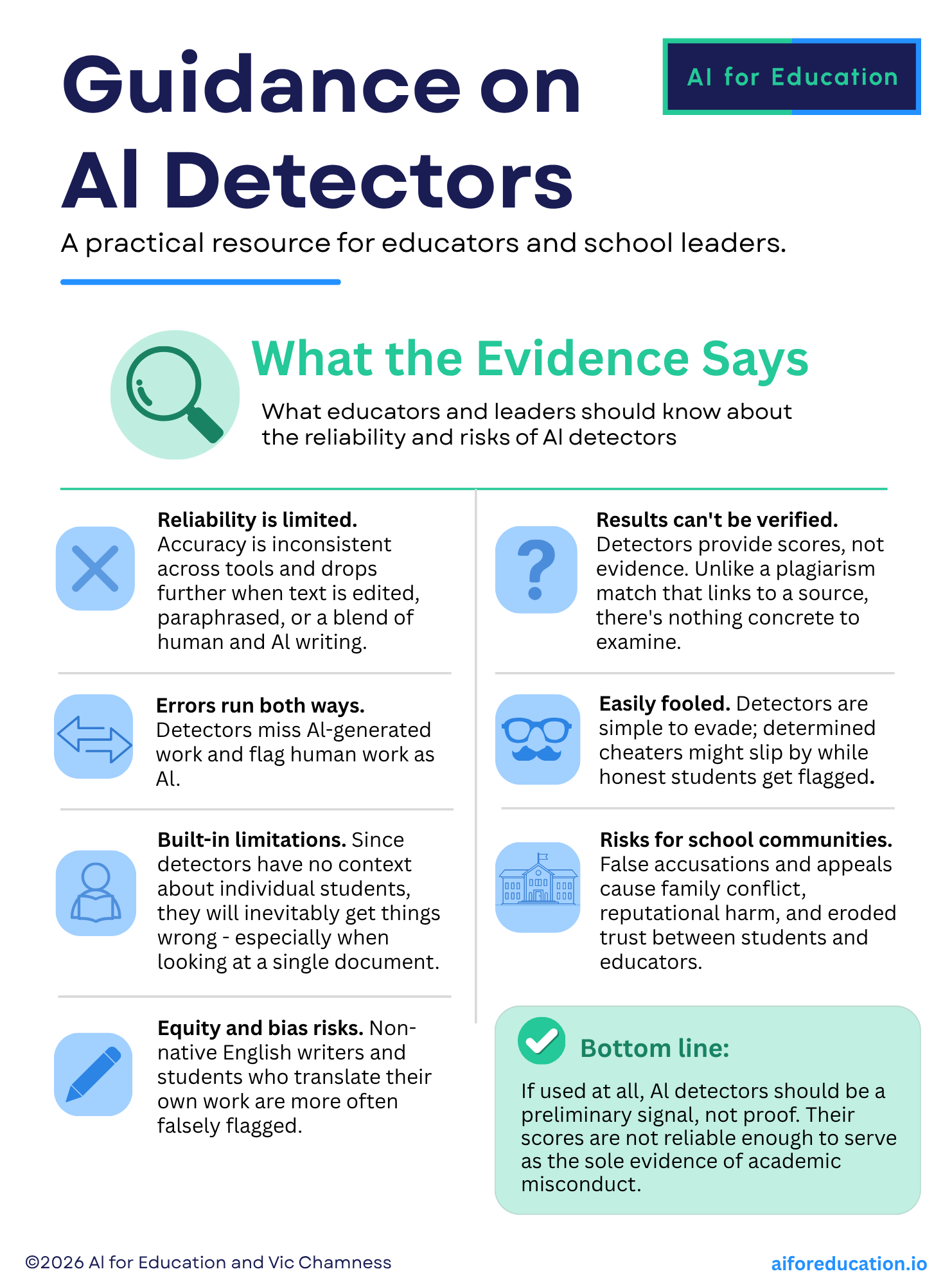
AI Detectors: What the Evidence Says
What educators and leaders should know about the reliability and risks of AI detectors
AI detector scores are not reliable enough to serve as the sole evidence of academic misconduct
Reliability is limited. Accuracy is inconsistent across tools and drops further when text is edited, paraphrased, or a blend of human and AI writing.
Errors run both ways. Detectors miss AI-generated work and flag human work as AI.
Built-in limitations. Since detectors have no context about individual students, they will inevitably get things wrong — especially when looking at a single document.
Equity and bias risks. Non-native English writers and students who translate their own work are more often falsely flagged.
Results can't be verified. Detectors provide scores, not evidence. Unlike a plagiarism match that links to a source, there's nothing concrete to examine.
Easily fooled. Detectors are simple to evade; determined cheaters might slip by while honest students get flagged.
Risks for school communities. False accusations and appeals cause family conflict, reputational harm, and eroded trust between students and educators.
Bottom line: If used at all, AI detectors should be a preliminary signal, not proof.
What To Do Instead
Safe, ethical, and effective strategies for responding to and preventing AI misuse
When You Suspect a Breach
Clarify expectations. What policies are in place? Was AI allowed, limited, or prohibited, and were students expected to cite or disclose its use
Review the work process. Check drafts, outlines, notes, and timestamps to see whether the process matches the product.
Conference with the student. Ask students to explain their ideas and choices. Seek to understand the work and process rather than confirm a hunch.
Compare multiple sources. Weigh the student’s work against prior writing and classroom performance, especially in-class or handwritten work.
Respond fairly and consistently. Apply school policy and professional judgment; if a concern remains, document your analysis and follow procedures.
Proactive Strategies
Redesign assessments. Switch to in-class writing, process portfolios, oral presentations, performance tasks, and measured, critical, and transparent use of AI.
Build AI literacy. Make AI disclosure a school-wide practice, teach critical evaluation of outputs, and center authentic voice and human judgment.
Bottom Line: Exercise your professional judgment, and respond with care and evidence. Prevent incidents with stronger assessments and AI literacy.
This resource was developed in collaboration with Vic Chamness, Director of Artificial Intelligence & Instructional Technology - Evansville Vanderburgh School Corporation
Sources
Ardito, Cesare Giulio. “Generative AI Detection in Higher Education Assessments.” New Directions for Teaching and Learning 2025, no. 182 (2025): 11–28.https://doi.org/10.1002/tl.20624.
Atamhenwan, Lucky E. “How Are Combinations of Human-Written Words and LLM-Generated Words by ChatGPT, Copilot, Gemini and Grammarly Detected by Turnitin?” Education and Information Technologies, ahead of print, June 4, 2026.https://doi.org/10.1007/s10639-026-14049-2.
Dutta, Arka, Utkarshani Jaimini, Utkarsh Bhatt, Sara Shree Muthuselvam, Amitava Das, and Ashiqur Rahman KhudaBukhsh. “A Large Scale Social Web Audit of AI Generated Text Detection Systems.” Proceedings of the International AAAI Conference on Web and Social Media 20, no. 1 (2026): 677–90.https://doi.org/10.1609/icwsm.v20i1.42660.
Garland, Nathan. “AI Detectors Fail Diverse Student Populations: A Mathematical Framing of Structural Detection Limits.” arXiv:2603.20254. Preprint, arXiv, March 11, 2026.https://doi.org/10.48550/arXiv.2603.20254.
Liang, Weixin, Mert Yuksekgonul, Yining Mao, Eric Wu, and James Zou. “GPT Detectors Are Biased against Non-Native English Writers.” Patterns 4, no. 7 (2023): 100779.https://doi.org/10.1016/j.patter.2023.100779.
Perkins, Mike, Jasper Roe, Binh H. Vu, et al. “Simple Techniques to Bypass GenAI Text Detectors: Implications for Inclusive Education.” International Journal of Educational Technology in Higher Education 21, no. 1 (2024): 53.https://doi.org/10.1186/s41239-024-00487-w.
Weber-Wulff, Debora, Alla Anohina-Naumeca, Sonja Bjelobaba, et al. “Testing of Detection Tools for AI-Generated Text.” International Journal for Educational Integrity 19, no. 1 (2023): 26.https://doi.org/10.1007/s40979-023-00146-z.