An activity that visualizes the process that drives safe, ethical, and effective GenAI decision-making and use
The SEE Framework defines GenAI literacy as the knowledge, mindsets, and practices that allow individuals to use GenAI safely, ethically, and effectively.
The SEE Snapshot is a short exercise that makes GenAI-literate practice visible. It can be used as a modeling or thinking exercise for educators, administrators, and students.
Directions
Choose a GenAI dilemma. Pick one from page 4, or write your own in the Dilemma row of the template on page 2.
Start with Knowledge. What does someone in this situation need to know about how GenAI works to make an informed decision?
ℹ️Review the “Knowledge of How GenAI Works,” “Common GenAI Misconceptions,” and “Knowledge of GenAI Core Ideas and Applicable Research” sections in the SEE Framework.
Move to Mindsets. Which of the five SEE mindsets — Be Intentional, Stay Critical, Be Transparent, Act Responsibly, Keep Learning — are most relevant? What questions do they raise?
ℹ️Review the “Mindsets for GenAI Use” section in the SEE Framework.
Decide on Practices. What safe, ethical, or effective decisions and actions result?
ℹ️Review the “Safe, Ethical, and Effective Practices of GenAI Literacy” section in the SEE Framework.
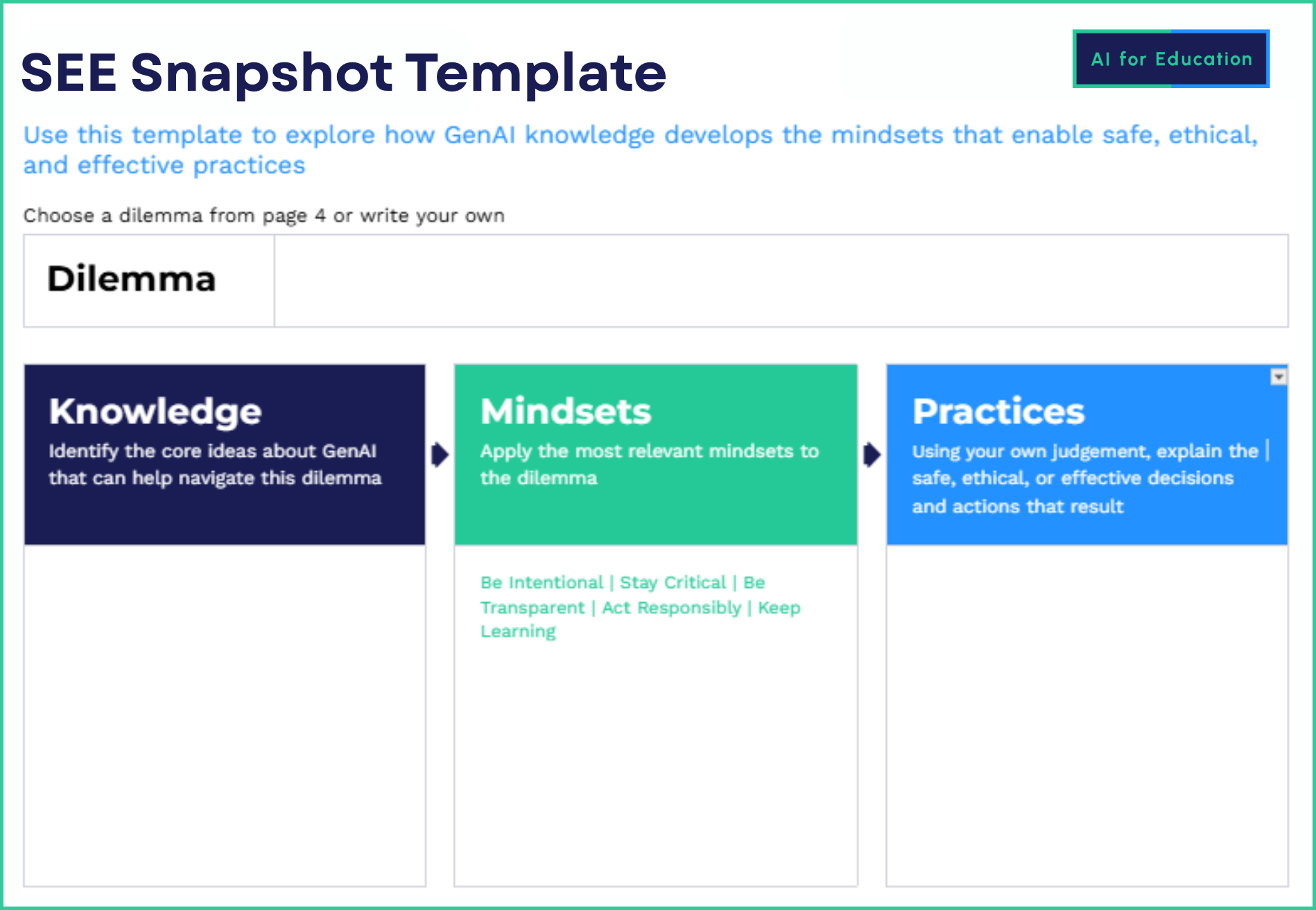
SEE Snapshot Template
Use the template to explore how GenAI knowledge develops the mindsets that enable safe, ethical, and effective practices
Dilemma: Choose a dilemma from page 4 or write your own.
Knowledge
Identify the core ideas about GenAI that can help navigate this dilemma
Mindsets
Apply the most relevant mindsets to the dilemma
Practices
Using your own judgement, explain the safe, ethical, or effective decisions and actions that result
SEE Snapshot Example
Dilemma: An educator considers whether to use AI to generate feedback on student essays.
Knowledge
GenAI might store, use, and share personally identifiable information (PII)
Outputs can reflect biases in the training data
Outputs can be incorrect and/or generic
Mindsets
Act Responsibly: What are the tool’s data privacy pitfalls and terms? Does the tool now own students’ work?
Stay Critical: How might hallucinations (i.e., inaccuracies) and bias in the feedback affect my students?
Be Intentional: How would my students feel if all of their feedback was from AI?
Be Transparent: How would they feel if I used AI and didn’t tell them?
Practices
Review the tool’s terms with leadership to see how they use students’ data, including their intellectual property
If approved, verify and revise any AI feedback before it reaches students
Disclose to students to what extent feedback is AI-generated or -assisted vs. human-created
Continue to write a short, personalized note on each essay if GenAI provides the majority of feedback
Sample Dilemmas
Educators and Educator-Leaders
A department head considers whether to adopt AI detection software to check student work for AI use.
A curriculum director evaluates several AI math tutors, one of which students would use independently for homework and test prep.
A special education teacher uses a district-approved AI tool to help draft and revise IEPs.
An elementary teacher considers whether to use a consumer chatbot to adapt and translate reading materials for English language learners.
A middle school teacher considers using a district-approved AI tool to record and summarize parent conferences.
Students and Families
A middle school student is required to use their school's approved chatbot for a science project.
A parent considers buying a GenAI storybook app that customizes stories to their child's interests and reads them aloud.
A high school student uses a consumer chatbot for relationship advice and finds it more useful than talking to people in their life.
A college student working on a group project considers using an AI writing tool to revise their group's presentation.
Administrators
An HR director considers using the district's GenAI tool to analyze exit interviews from teachers who left the district over the past two years.
A superintendent considers whether to use the district's GenAI tool to analyze student attendance and performance data.
A district technology director considers adopting AI monitoring software that tracks students’ emails, chats, and web history for safety concerns.
A principal considers using a GenAI recruiting platform to rank and then phone screen initial applicants for a teaching role.